Waste-sorting robot
How can feeding, visual recognition, hopper sorting and collection operate as one prototype?
- Current output
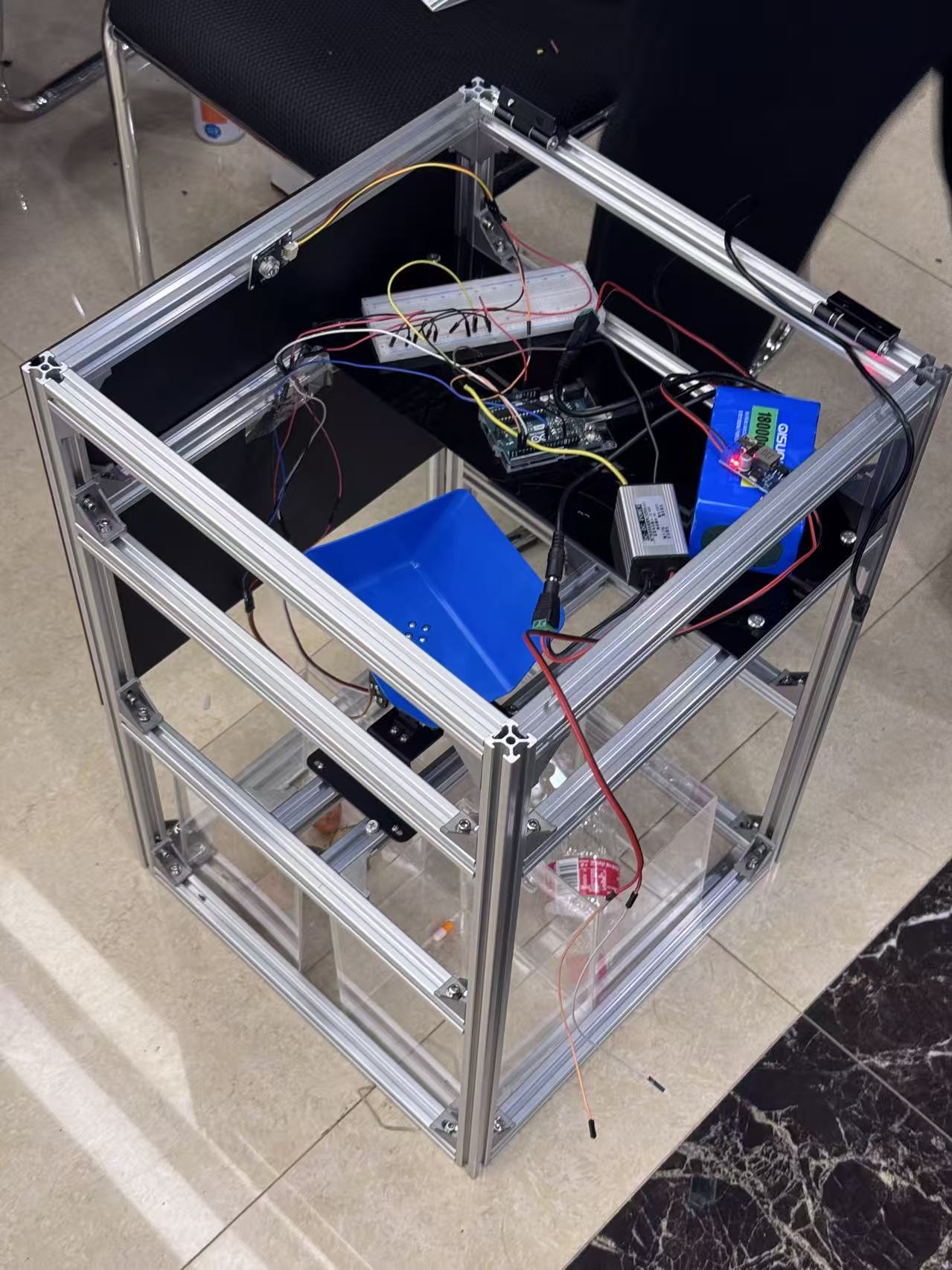
- A complete frame, feeding and sorting mechanisms, custom mounts and enclosure, with physical assembly and collaborative integration.
- My role
- Team lead responsible for mechanical and enclosure design, with participation in assembly and integration. Recognition and control were team work.
Give the material a complete sorting path
Material passes through feeding and visual recognition before the hopper directs it to a collection area. I organised the mechanical stages so each exit meets the next working position.
Mechanical design and team coordination
As team lead, I was responsible for mechanical and enclosure design. I used SolidWorks to organise the frame, feeder, hopper, bins, panels and device mounts, and participated in fabrication, assembly and integration.
Give vision a controlled lighting environment
The team tried YOLOv10 and YOLOv11. During debugging, we found that changes in light strongly affected waste recognition: external sunlight changed the brightness and colours seen by the camera.
I added a black acrylic cover around the recognition area to block external light, using an internal lamp for illumination. Bringing the visual environment into mechanical design was one way I adapted the structure for the vision system.
Change the hopper from white to purple
The hopper was originally intended to be white, but many waste objects had similar colours, making the target and background harder to separate. I painted it purple to create a more distinct visual background.
The cover changes the lighting conditions; the hopper colour changes the background. Both revisions grew out of debugging and made the enclosure and surface finish part of the recognition process.
From CAD to integrated debugging
I also FDM-printed camera mounts, adjusting holes and fixings for the viewing direction and physical fit. After installing cameras, servos, motors, sensors and controllers, I worked with the team to connect feeding, recognition, sorting and full-bin detection.